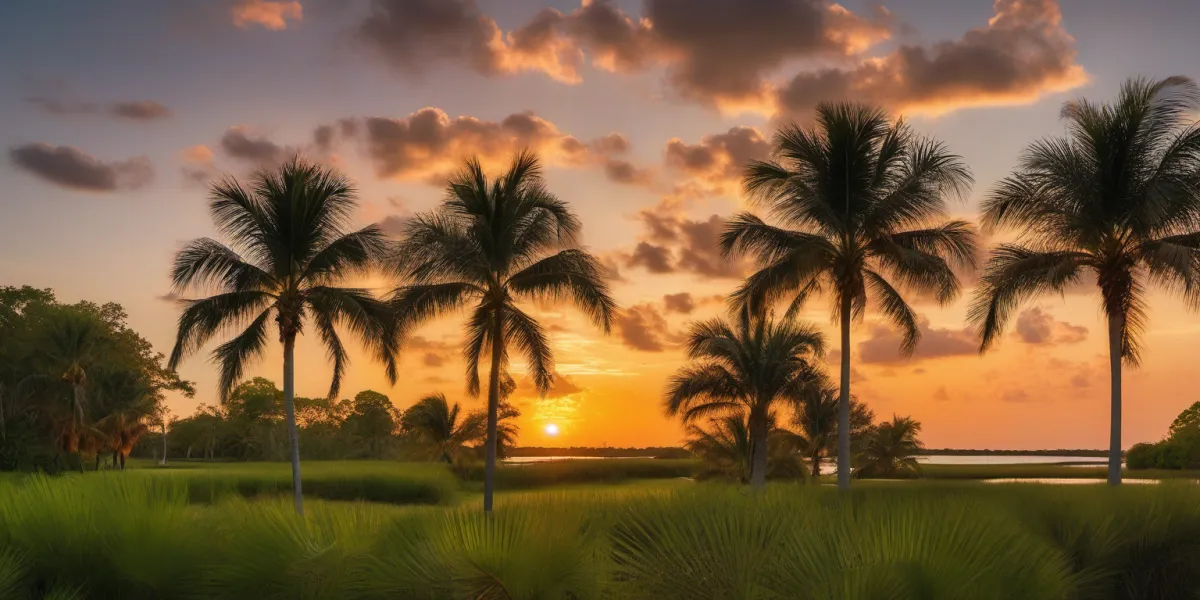
Tampa Bay is where the Florida palm map starts to change. Drive south from Sarasota and almost anything grows. Drive north into Brandon, Wesley Chapel or Spring Hill and a handful of winter nights every few years decide which palms live and which ones turn into brown poles. Here is what actually survives, ranked the way we would plant it in our own yard.
One paragraph on Tampa Bay winters
Most of the coast, from St. Pete Beach up through Clearwater and down to Bradenton, sits in USDA zone 10a. The bay and the Gulf hold heat, so the coldest nights usually stay above freezing. Move a few miles inland to Brandon, Riverview, Wesley Chapel, Lakewood Ranch or New Port Richey and you are in zone 9b. Inland yards see frost most winters, and every few years a strong front pushes overnight lows into the upper 20s. That is the number that matters. A palm that shrugs off 27 degrees is a permanent part of your landscape. A palm that dies at 30 is a tenant.
The cold-hardy workhorses
1. Sabal palm (cabbage palm)
The state tree of Florida and the toughest palm you can buy. Sabals are native from here to the Carolinas, handle temperatures well below 20 degrees, stand up to hurricanes better than anything else in the yard, and tolerate salt, drought and wet feet. They are sold by trunk height, they transplant well as field-grown specimens, and they look right in front of every style of house in Tampa Bay. If you want a palm you never think about again, start here.
2. Sylvester palm
The Sylvester palm is the palm people picture when they say "statement palm." Silver-green fronds, a thick diamond-cut trunk, and cold tolerance into the low 20s, which covers every inland Tampa Bay winter in recent memory. It grows faster than a Canary Island date palm and costs less at the same trunk height, which is why it anchors so many entries and pool decks from Sarasota to Tampa. Give it full sun and room, because the crown spreads to 15 feet or more and the fronds carry spines at the base.
3. Pindo palm
The pindo palm is the small-yard answer. Blue-silver fronds that arch back toward a stout trunk, a mature height around 15 to 20 feet, cold hardiness down into the teens, and real salt tolerance for coastal Pinellas. It is slow, which is a feature in a front bed next to the house. The orange fruit is edible and makes a traditional jelly, though it is messy over a driveway, so give it a bed.
4. Mule palm
A mule palm is a hybrid between the pindo and the queen palm. It has the tropical, feathery look of a queen with cold tolerance close to a pindo, and it does not get the frizzle top and nutritional problems queens are known for. Mule palms are grown in smaller numbers than the palms above, so they cost more per foot, but for an inland yard that wants a queen palm look without the winter gamble, they are the right call.
5. Canary Island date palm
The Canary Island date palm is the estate palm. A trunk two to three feet across, a crown wider than most driveways, and cold tolerance close to a Sylvester. The catch is scale. It needs a big lawn, it should never sit within reach of a walkway because of the spines, and it is slow, so a mature specimen is a serious purchase that we quote by size. On a large Lakewood Ranch or Odessa lot it is unmatched.
6. Queen palm
The queen palm is the most planted palm in Tampa Bay for a simple reason: it is fast, tall and affordable. It also gets damaged in the mid-20s and has a well-earned reputation for frizzle top, a manganese deficiency that shows up in our alkaline, shell-filled soils. Queens are a fine choice if you fertilize them with a palm fertilizer that includes manganese and you accept some frond burn after a hard freeze. Plant them in groups of three at staggered heights and they look far better than a single pole.
7. Washingtonia (Mexican fan palm)
When you need height fast along a property line or a long driveway, the Washingtonia palm is the tool. It can add several feet a year, handles cold near 20 degrees, tolerates salt and drought, and eventually towers over everything. That is also its weakness on a small lot: a 50-foot palm with a skirt of dead fronds needs a bucket truck to trim. Use it where it has sky above it and nothing precious below.
Marginal palms that can work on the coast
If you live on the water in St. Petersburg, Clearwater, Apollo Beach or Anna Maria Island, the extra few degrees change the list. Bismarck palms, Chinese fan palms, European fan palms and even areca palms and pygmy date palms do well in most winters near the water, with some leaf burn in the bad ones. Foxtail and royal palms are a gamble even on the coast, and both need a plan for what happens when a 28-degree night arrives, because it will.
Palms we talk people out of inland
Coconut palms, foxtail palms, Christmas palms, bottle palms and spindle palms belong south of Sarasota. In Brandon, Riverview, Wesley Chapel, New Port Richey or Spring Hill they will look great for two or three winters and then a single cold night takes the crown. We would rather sell you a mule palm that is still standing in twenty years.
How palm pricing works in Tampa Bay
Palms and trees are quoted by size, usually by feet of clear trunk for Sylvester and Canary Island date palms and by overall height for queens, sabals and Washingtonias. Delivered-and-planted pricing includes the dig, the set, staking and the first watering, with a $500 minimum on any order and a trip charge that we quote by county for Tampa Bay addresses. Prices may differ, so request a quote for your exact number. Browse the full lineup on our palms page or send us a photo of the spot through the quote form.
Talk to the Tampa Bay team
Our Tampa Bay crew plants from Sarasota and Bradenton up through Tampa, St. Petersburg, Clearwater, Wesley Chapel and Spring Hill. Tell us the city, the sun exposure and the look you want, and we will match a palm that will still be there after the next hard winter. Call (239) 799-5594 or text (239) 763-0625, or request a quote online and we will send a delivered-and-planted price.