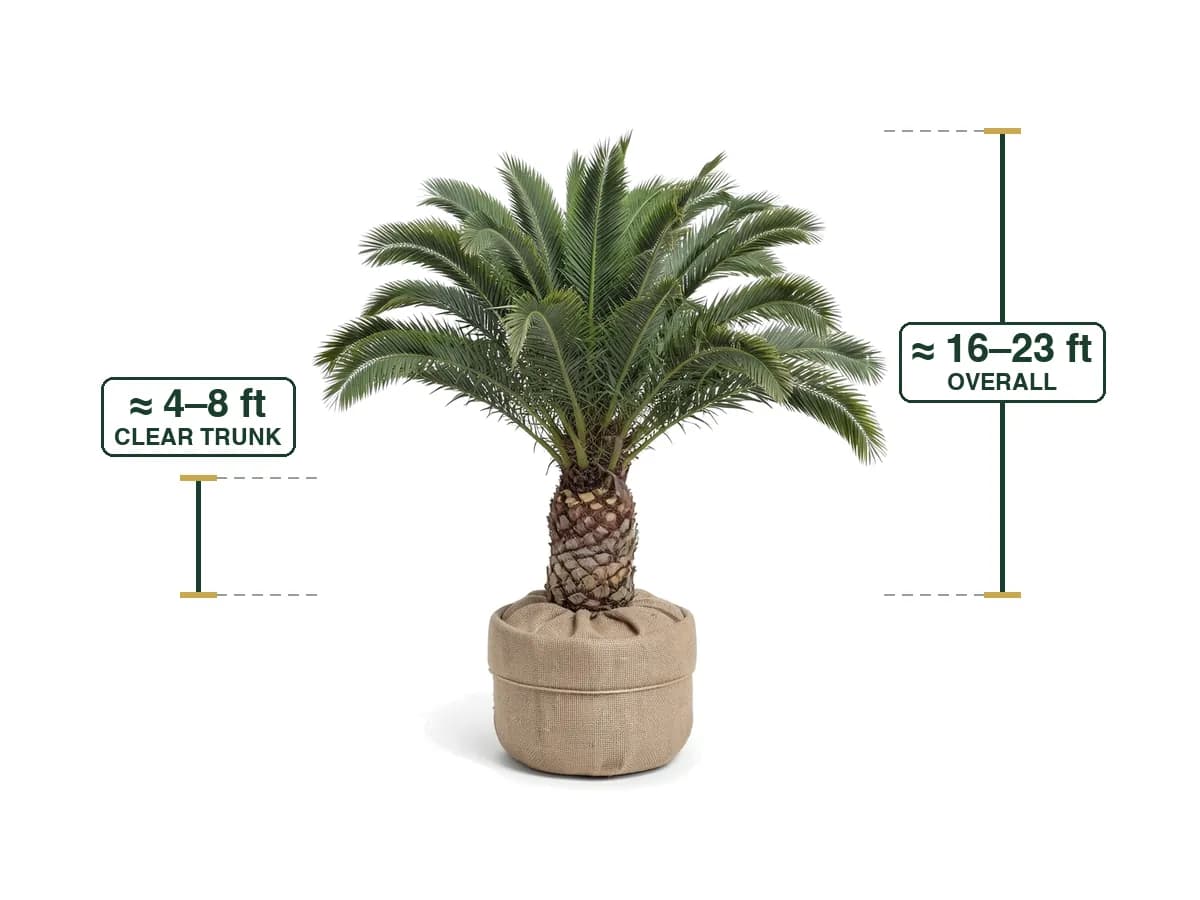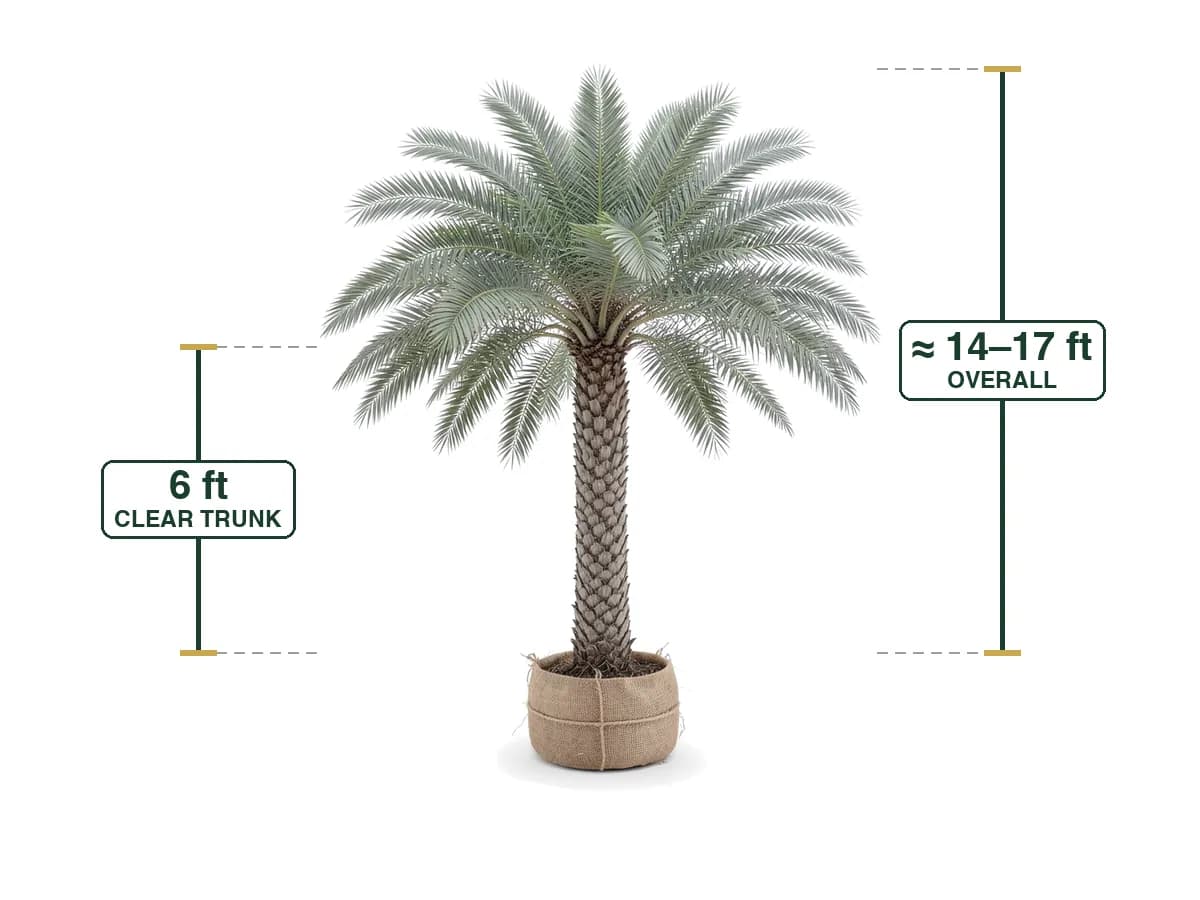
Two palms, one silhouette, very different price tags. The Sylvester palm and the Canary Island date palm are cousins in the Phoenix family, and from the street a lot of Sarasota and Bradenton homeowners cannot tell them apart. Up close, and on the invoice, they are not the same tree. Here is how we help people choose.
The short version
Choose the Sylvester palm if you have a typical quarter-acre lot, you want the diamond-cut trunk look on a reasonable budget, and you want the palm to reach its full look in your lifetime. Choose the Canary Island date palm if you have a large lot, a long driveway or an estate entry, and you want the biggest, heaviest crown a palm can produce in Florida. Both handle Sarasota and Bradenton winters without trouble.
What they look like
The Sylvester palm (Phoenix sylvestris) carries a crown of silver-green to blue-green fronds on a single trunk that, when the old frond bases are trimmed, shows the diamond pattern everyone photographs. Mature height is in the 40-foot range, but it takes decades to get there, and the crown spreads roughly 15 to 20 feet.
The Canary Island date palm (Phoenix canariensis) is simply bigger in every direction. The trunk can reach two to three feet across, the fronds are a deeper green, and a mature crown can span 25 to 30 feet. Landscapers often prune the lower fronds into the "pineapple" shape below the crown, which shows off the trunk and makes the palm look even more massive. Nothing else in a Florida yard reads as expensive from the road.
Growth rate and time to "the look"
This is where most people make the decision. A Sylvester palm that goes in with six to eight feet of clear trunk already has the look. A Canary Island date palm is slow, especially in the first years after transplant. Field-grown Canaries are sold at sizes that already carry the big trunk, and that size is what you pay for. If your budget is fixed, the same dollars usually buy a noticeably larger Sylvester than Canary.
Cold hardiness in Sarasota and Bradenton
Both palms are among the hardiest feather palms you can plant. Coastal Sarasota and Bradenton sit in zone 10a, and neighborhoods east of I-75 like Lakewood Ranch, Parrish and Myakka City are zone 9b, where a cold front can push lows into the upper 20s every few years. Sylvester and Canary Island date palms handle the low 20s with little more than tip burn. Compare that to a foxtail or a coconut, which can be lost in a single night at the same temperatures, and you understand why these two show up at every inland neighborhood entry.
Space, spines and the things nobody mentions
Both palms have sharp spines at the base of every frond. Keep them at least eight to ten feet from walkways, pool cages and play areas, and plan for trimming by someone with the right gloves and tools. Both produce dates. Sylvester fruit is small and orange and mostly a bird snack; Canary fruit drops in heavy clusters, so keep it out of a bed beside the driveway or off the pool deck. Canary Island date palms also need far more room than people expect. A crown that wide belongs in a lawn or a large island bed, not in a four-foot strip between the house and the sidewalk.
Health issues to plan for
Both are Phoenix palms, which means both can be affected by lethal bronzing, a bacterial disease spread by a planthopper that has been present in the Tampa Bay and Manatee County area for years. Signs are fruit dropping early, lower fronds turning a bronze color and the spear leaf collapsing. Preventive trunk injections are available through certified arborists. Canary Island date palms are also known for fusarium wilt, a fungus spread on dirty pruning tools, and for potassium and magnesium deficiencies that show as yellow or spotted older fronds. None of this should scare you off. It means buy a healthy palm, fertilize it with a proper palm fertilizer, and make sure whoever trims it sanitizes the saw.
What each one costs
Palms are quoted by size. For Sylvester palms that usually means feet of clear trunk; for Canary Island date palms it means trunk height and overall size, because a Canary with three feet of trunk is already a very large plant with a very heavy root ball. Delivered-and-planted pricing includes the equipment to set a palm that can weigh well over a thousand pounds, the staking and the first watering. Every order carries a $500 minimum, and Sarasota and Manatee County addresses carry a trip charge that we quote by county. Prices may differ, so request a quote for your exact number.
Planting day for a Phoenix palm
Both palms arrive field-grown with a burlapped root ball that can weigh more than the palm itself, so planting day involves a machine, not a shovel and two friends. The hole is dug to the depth of the root ball and no deeper, because a Phoenix palm planted too deep will sulk for years. The palm is set plumb, backfilled with the native sand, watered in to settle air pockets, and braced with padded stakes that never nail into the trunk. Keep the braces on through the first summer, water deeply and often for the first few months, and hold off on fertilizer until the palm has pushed new growth.
Our honest recommendation
For most homes in Sarasota, Bradenton, Palmetto and Venice, we plant a Sylvester at the front corner of the house or beside the driveway, sometimes as a pair flanking an entry. For a large lot, a corner property or a long approach, a single Canary Island date palm in the center of the lawn becomes the landmark the whole street knows. If you cannot decide, send us a photo of the spot with a rough width measurement.
Ready to compare quotes?
Our Tampa Bay team delivers and plants both palms throughout Sarasota, Bradenton, Lakewood Ranch and Venice. Request a quote with your address and the trunk height you have in mind, or call (239) 799-5594 and we will walk you through sizes and availability.